
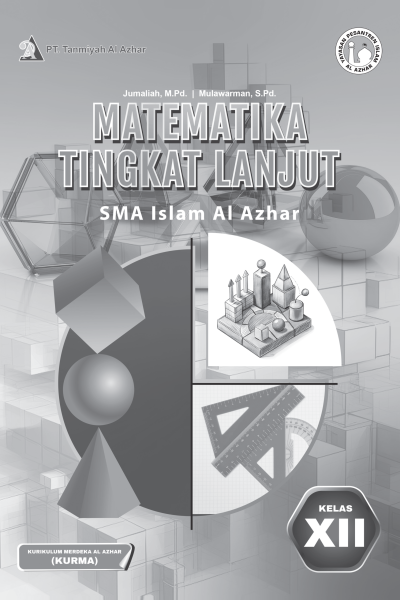
General Framework for 8th Grade Mathematics (Independent Curriculum)
The Independent Curriculum in Indonesia emphasizes student-centered learning, flexibility, and in-depth understanding. Here’s a possible structure for the Mathematics curriculum:
- Themes/Topics: The curriculum is organized around broad themes rather than rigid subject divisions (though the themes will likely align with core mathematics concepts).
- Flexibility: Schools have the autonomy to adapt the curriculum to their local context and students’ needs.
- Focus on Mathematical Skills: Development of skills like problem-solving, logical reasoning, critical thinking, and communication is crucial.
- Relevance: Connecting mathematical concepts to real-world issues and students’ daily lives is emphasized.
- Character Building: The independent curriculum also aims to develop students’ character.
Possible Themes and Content for 8th Grade Mathematics at Al Azhar (with Islamic Perspectives)
Here’s a sample outline, keeping in mind the integration of Islamic perspectives:
Theme 1: Numbers and Operations
- Content:
- Review of basic operations with integers, fractions, and decimals.
- Exponents and scientific notation.
- Square roots and cube roots.
- Number patterns and sequences.
- Financial mathematics: profit, loss, simple interest, zakat.
- Islamic Perspectives:
- Discuss the importance of fair and honest calculations in trade and finance (connecting to Islamic economic principles).
- Explore the mathematical concepts in Islamic inheritance laws (fara’id).
- Use examples related to zakat and its calculation.
Theme 2: Algebra
- Content:
- Linear equations and inequalities in one variable.
- Systems of linear equations in two variables.
- Algebraic expressions and their simplification.
- Introduction to functions.
- Islamic Perspectives:
- Use algebraic concepts to solve problems related to fair distribution (e.g., inheritance, business partnerships).
Theme 3: Geometry
- Content:
- Lines, angles, and their properties.
- Triangles, quadrilaterals, and other polygons.
- Circles and their properties.
- Pythagorean theorem.
- Surface area and volume of basic geometric shapes.
- Transformations: translation, rotation, reflection.
- Islamic Perspectives:
- Explore the geometric patterns and symmetries in Islamic art and architecture (e.g., tessellations in mosques).
- Discuss the mathematical principles behind the construction of mosques and other Islamic structures.
- Connect geometric concepts to the design of prayer spaces and the direction of the qibla.
Theme 4: Data Analysis and Probability
- Content:
- Collecting, organizing, and displaying data (tables, charts, graphs).
- Measures of central tendency (mean, median, mode).
- Basic probability concepts.
- Simple statistical analysis.
- Islamic Perspectives:
- Discuss the importance of accurate record-keeping and data analysis in Islamic finance and administration.
- Explore the concept of probability in the context of risk and decision-making, keeping in mind the Islamic belief in qadar (divine will).
Key Features of Learning:
- Inquiry-Based Learning: Students are encouraged to ask questions, investigate, and construct their own understanding.
- Problem-Based Learning: Students work on extended projects that integrate multiple concepts and skills.
- Contextual Learning: Connecting mathematics to real-world problems and local contexts.
- Collaborative Learning: Students work together in groups to solve problems and share ideas.
- Integration of Technology: Use of technology for calculation, data analysis, and presentation.
- Assessment: Authentic assessment methods, such as projects, presentations, and portfolios, are used to evaluate student learning.
Additional Considerations for Al Azhar Schools:
- Arabic Language: Where appropriate, mathematical terms can be introduced in Arabic, connecting to the broader curriculum at Al Azhar.
- Islamic Values: The curriculum should reinforce Islamic values such as precision, accuracy, fairness, and the pursuit of knowledge.
- Community Engagement: Students may be involved in community projects that involve mathematical applications (e.g., calculating zakat, designing community spaces).